Saturday, 7 March 2009

Think global, drink local

I've had goose-pimples twice already today. Perhaps a literature festival wouldn't be an instant thought for thrill-seekers but two talks today really got my blood flowing.


Firstly, a talk with Justin Marozzi and John Gimlette, chaired by local travel writer (is that an oxymoron?) and lecturer Joe Roberts. Both writers have documented their experiences with interesting travelling.


An encounter with an American GI led Mr Gimlette to retrace the US Forces' path up the Western Front in WWII with this 86 year-old veteran of the campaign, Putnam Flint. Gimlette chronicles the journey in Panther Soup, the soup of the title being the muddy mess that the American Panther Division left in their wake. This is an insight into the war and a personal story of a soldier coming to terms with the actions, both necessary and repugnant, of his army.

Justin Marozzi's wingman for his book The Man Who Invented History was Herodotus, the much-maligned Exaggerating Great-Uncle of History, or the Father of Lies, as some would have it. Amongst academics, Herodotus is seen as a fine stylist but a 'bullshit artist,' Marozzi explains to those of us who don't know (don't tell me I'm the only one never to have studied Greek classics.) But Marozzi likes the old chap for the very reason Plutarch et alii show such disdain for him - he's readable, he's an 'amiable buffoon' and he is a 'barbarian-lover'. A story-teller with an actual interest in the peoples he visits? Yes, he sounds like a decent sort to me as well.


Goose-pimple No 1: History reclaims some sensory, human detail.


Later, author of Real England Paul Kingsnorth and photographer Adrian Arbib give a rip-roarer of a seminar on the branding and blanding of the British landscape. Not for the first time at the Fest, we're talking about the effects of globalisation here - homogenisation, the dilution of culture and the death of the community as the supermarkets and developers roll out their grey monoliths. Two case studies from Kingsnorth laud the diversity of British apples and the importance of the good old-fashioned British pub. This is a popular theme in the media at the moment - recent noises have come from, amongst others, long-running activist Prince Charles - and more power to them.


Arbib further illustrates the importance of this activism with examples close to home (Solsbury Hill) to those further afield (developers in Oxford feeling the full force of the opinions of the British public.)

Kingsnorth feels vindicated by the recession. As a Marxist friend joked recently - capitalism is a lovely idea in theory but it just doesn't work in practice. 


Goose-pimple No 2: the battle for English culture puts my dander up.


My hunger for rabble-rousing whetted, I hit the streets. And, after a big, long, late lunch with two American MA Writing students discussing drinking culture home and away, I'm feeling like a big, long, late nap. When I wake up, I think it would only be right to show my support for my local ale house.


In between, my tip for the evening slot is more pomes. Claire Crowther and Greta Stoddart read from their own work and talk to poet and lecturer Carrie Etter, 7pm in't Guildhall. Have a good Saturday night - the week has whizzed past hasn't it?


Sam 'The Uncommon' Reader

Friday, 6 March 2009

Fambly

More queue-based gossip for you, fellow book-worms. Young actor, writer and all-round good-egg Ben Crystal caused a bit of a stir at book-signing time. His energetic, interactive talk was so poular that theme-park style queues quickly formed.


It's been a bit of a week for dynasties. It's something writers will often, understandably, distance themselves from to prove their own worth but, just for some factoid-fun... Harry Mount is the cousin of a Mr D Cameron, Ruth Padel is of course the great-great grandaughter of old Chazzer Darwin, John Hemming's mother was a well-known journalist, Misha Glenny is, of course, married to Kirsty Lang, and vice versa. And Ben Crystal is son of living-linguistic-legend David Crystal. With a gene pool that deep, no wonder the autograph-hunters have been out in force. No diving from the shallow end and no heavy petting, please.


Last night I went for some poetry. Tim Liardet kicked off the start of a new season of Bath Spa Stand-Up Poetry with Vicki Feaver and Catherine Smith. It were right good. Tonight, in a continuing of the Focus on Hungary theme, Mr Liardet will be in conversation with Anna Szabó & George Szirtes. For those of you unfortunate folks who missed out on a ticket for George Monbiot, I'd recommend this one.


Sam 'The Uncommon' Reader
Longest Line in Guildhall History (and still time for some family advice)

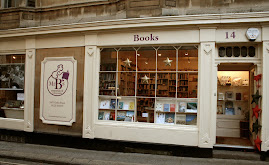
Mr B dropping in to report that the signing line for Alexander McCall-Smith was eventually completed with every customer trotting into the night gleefully clasping their new signed books.

The longest signing line in Guildhall History I overheard one official saying, but the incredibly charming Mr McCall-Smith still had time and energy to sign a mighty pile of them for the Mr B's festival shop for anyone who wasn't able to wait in line.

And even after he completed that Kilimanjaroesque pile of signing, he was still keen to stick around for a brief chit chat about books, bookshops and all sorts, which resulted in me going away with some top tips for my impending fatherhood in May. The sound advice from one of Britain's most popular and prolific novelists is to be there, to enjoy every moment, to cry buckets once it's all over but to stay firmly at the top end of the bed throughout. That sounds infinitely sensible if you ask me.

Posted by 'Mr B'

Blooming heck!

Today's tenuous link: green. The Festival's palette; the seats at the Guildhall; my ill-advised cords-and-wool-shirt combo today (cor, what a scorcher!); the fingers of the British.


Andrea Wulf (favourite flowers - lupin? Ho ho) presented from her book The Brother Gardeners, adding to the Festival's richly global fare. So far, amongst others, we've had a Pakistani talking about America, we've had a Chinese lady talking about Tibet, we've had a Czech-American talking about Germany. Andrea Wulf is an Indo-German talking about us weirdo, lawn-hoovering Brits.


In the 18th century, a key band of botanists exploited the colonial trade routes to nurture their budding (sorry, so sorry) interests in all things green. Our cast: British Quaker, Peter Collinson; an American horticulturalist, John Bartram (incidentally, another Quaker); Philip Miller, Chief Gardener at the Chelsea Physic Garden; Swede Carl Linnaeus; Joseph Banks (of Captain Cook and Mutiny on the Bounty fame); Daniel Solunder, another Swede. Check out the book - they're a dashing bunch.


Theirs is a story of transatlantic fraternal bickering. Their legacy is that of an expansive vista of evergreens and spring shrubs. In Andrea Wulf's words, a 'quiet flower revolution.' Look, I can't pretend to be a gardener. I live in a flat. My wife and I buy pots of basil from the supermarket that last a meal and promptly wither and die on us, as if to say 'you're bad parents, you're bad north-facing fungal people'. No, I'm no gardener. But a quiet flower revolution? Even I can dig that. (Yes, sorry.)


The aristocracy of the day had topiaries and straight lines and something close to a modern German garden - Ms Wulf describes how her neighbours in Germany called the police to report a hedge that was too close to the pavement. In the 1780s though, thanks to these early pioneers of gardening, 'the corset that was imposed on nature was slowly opened.'


Here is an aside: does working in mud mean mind in the filth? I'm thinking of Mr Titchmarsh, whose novels have something of a reputation (nudge et wink). Ms Wulf reveals that Linnaeus 'failed to persuade the British to adopt his sexual system' of classification as it was 'too smutty'. Descriptions of plants as mistresses abound. Cross-sections of flowers' licentiousness. Passion. It's all a bit... seedy. (No, really, I'm sorry). And, speaking of the sexual behaviour of flowers, do you remember yesterday's 'fraternal polyandry'? The blushing beetroot? We're coming full circle, dear friends.


But Britain's relationship with green spaces is complicated and strong. I don't need to tell you - just look at Bath's waiting lists for allotments.


Enough now. It's way past your bed time.


Sam 'The Uncommon' Reader

Wednesday, 4 March 2009

Who wouldn't want to come back?

Former child-soldier, writer and rapper Emmanuel Jal told me he'll be back. Bath has clearly made a good impression. Between sell-out readings at the Fest he was at City of Bath College doing some fine work with music students there and he enjoyed himself so much he vowed he'd return.


Meanwhile, Sun Shuyun gave a Chinese view of Tibet free of jingoism, free of the Party line, free of hippy cliches about Shangri-La. Instead we got stories of real actual people in a real actual country - hotelier, shaman, child labourers, monks and so on. Stark economic realities in an occupied country. The quotidian problems faced by a singularly religious, rural population. And I learnt a new word - fraternal polyandry (for mainly economic reasons, very popular in this particular region of Tibet). Forgive me - for my ignorance and my innocence - but it made me blush like a coy little beetroot in a silk stockings factory. A vegetable's silk stocking factory. It could happen.

Um.

Night night.


Sam 'The Uncommon' Reader

Wednesday

Morning all.

On Monday at the Festival I bumped into Frances Ann King, a recent graduate from the BA Creative Writing at Bath Spa. She's already making waves as a poet in her own right - see, for example, Editor's choice this month in Rialto magazine. Excellent stuff. If you fancy catching up with what the current crop from the MA Creative Writing are up to, check out New Writing at 8.30pm at the Rondo tonight.


My other tip for the day is Jenni Murray at 4.30pm in the Guildhall. But I'm sure that was already on your radar.

Out of interest - on this day in 1861, Honest Abe was inaugurated (see yesterday's post). On the literary front, on this day in 1852, Gogol died. Meanwhile, John Terry is 30 today.


Sam 'The Uncommon' Reader

Tuesday, 3 March 2009

Funny weather we're having

Have you braved the weather then? You brave things!  What did you see tonight? That's not a hypothetical question - let's get some conversation going here. It's strangely quiet, but I know you're out there in the darkness. Don't let me hog all the limelight. I know there were people left itching for the microphone earlier tonight.


Bronwen Maddox, Ziauddin Sardar and Scott Lucas engaged in a discussion chaired by Helen Taylor - The World Today: America and Britain. In a word? Tantalising. As Scott Lucas pointed out, a discussion like this could take seven or eight hours. Look, I know Nic Bottomley had his heart set on going to this one so I'll do my darndest to say something sensible and meaningful with it. Poor old bean was busy orchestrating book sales for three events simultaneouswise. They're like buses, these things. (I think we all know he wouldn't have it any other way really.)


The panel's clear, informed messages did much to elucidate and explore a topic which is at the fore of our national psyche. Its importance permeates our culture. With the current economic situation linking our two nations as much as our recent joint forays into questionable foreign policy and misadventure, the roles and the responsibilities of America and Britain in a global context took centre stage.


With the hour speeding by, this well-structured discourse did occasionally and inevitably slip into cross-firing pub banter, albeit with professorships for beermats and transcontinental experience for session ale.


And that might have been the most interesting aspect of the conversation. We were graced with three forceful academic minds - one whose background is American-English, one whose is more stoutly American, and one whose is Asian-English. And their world views didn't sit exactly how you might expect - with each revelation the shift in  atmosphere was audible. There were mutters of approval. Sighs and  fidgets as knickers twisted and untwisted. At one point there was an uncontrolled bark of disagreement and later relieved laughter. At the close, two hearty rounds of applause.


This one could've run on into the night. Please do commit finger to keyboard if you'd like to continue here.


Sam 'The Uncommon' Reader

A rose by any other name

Ah. The breath of the morning. The sparrow's croak. Breakfast. On Radio 4, UniversityChallengeGate rages on. Ah. How are you feeling today?

Last night whispers were circulating around the Festival about authors (who will remain anonymous) suffering from Repetitive Signature Injuries. One signed a book to the wrong person, one signed a book to himself... Well. Sometimes a name just slips out of reach. I suppose it's an understandable symptom of the leviathan workload that comes with a commitment to one's art and one's fans.

On an unrelated note (although I am sure she is just as committed), Yasmin Alibhai-Brown last night proved herself a fluent and instantly loveable raconteur. She describes herself as a 'national irritant'. Michèle Roberts has another view of her - 'national treasure'. Alibhai-Brown's new book The Settler's Cookbook, which she explains she had to write as a means of making her mother alive again, is also a means of documenting a generation that is slowly passing on without any of their stories written down. When she dies, she jokes, she hopes her (presently indifferent) children will read it and 'feel a bit guilty!' If you missed it, it's Book Of The Week next week on Radio 4. As ever, it's also available at Mr B's Emporium.

Recommendation for the day, as per the advice of Mrs Alibhai-Brown, is another Yasmin. Yasmin Hai and Ziauddin Sardar reading at 1pm today in the Guildhall. 'It's a beautiful book,' she advises of Yasmin Hai's memoir The Making of Mr Hai’s Daughter. See you there.

Meanwhile, the kettle's boiling. Speak later.


Tom Writer

Monday, 2 March 2009

A story I'm not allowed to tell

Day Three. Ron Jonson tells a story that I'm not allowed to write. He's promised his son it won't ever be published. It's a funny, funny story.


Here's my own little kitchen sink drama for you instead then. I'm sitting in the front row of a small auditorium with my pen and my notepad. I'm not a real journalist, and as a volunteer I'm not even a proper employee of Mr B's and, by extension, the LitFest. But the nice Steward (well, they're all nice, aren't they) has sent me to the front where there are seats with 'RESERVED FOR FESTIVAL STAFF' signs. She has done this because when she asks for my ticket at the door I peel back my jacket to reveal my Mr B's badge and coolly say, 'I'm writing a blog for Mr B's.' But I don't say it very coolly. My voice breaks a little. Like a chair being pulled out. And I stutter. She gives me a 'poor love' look and directs me to the front row out of sympathy.


A few seats along, in the front row but not in Festival Staff seats, there are a couple of ladies arguing. This is good, I think. I can write about this. If I write about this in my notebook, I think, people around me will think I'm a writer and won't question why I'm sitting in such a good seat. The women are bickering. I write, 'mad women bickering in the front row' in my notebook and I give a little laugh. Ha ha. I am funny. I am a funny, funny writer. Why don't I send some of this stuff to a newspaper? This is good stuff.


One of the women moves seats and sits behind me. I feel sure she can read what I'm writing. It's good stuff, why wouldn't she want to read it? I look down at the notepad. Mad women bickering, it says. I put my notepad away.


After introducing the speaker, the Festival Producer sits down next to me in one of the seats for Festival Staff. I stick out my chest a little to show my badge off. It's suddenly awfully small. Has she seen it? She hasn't seen my teeny tiny badge.


At the risk of a face-off with the bickering woman, I pull out my notepad and, quickly flicking to a page sans mad women bickering, or shopping lists, pretend to write about what the speaker is saying. The audience chuckles. The Festival Producer chuckles. I chuckle knowingly and smile at her. And go back to the notepad with a face that says, 'this is good stuff, this is a funny, funny speaker.'


But I haven't been listening. So I draw a bad picture of the speaker. Here the speaker tells a story that he's promised his son he won't publish. It's just too good. But, because I can't write the story, I carry on drawing my silly picture of the speaker.


Afterwards, I ask one of the pretty members of Mr B's happy helpers (i.e. not me) to ask the speaker for a sound-byte for the blog. She doesn't have any paper so takes my notepad and pen.


Opposite me, there's a group of Festival Staff. The Nice Steward, the Festival Producer and some other women that I don't know. I get the feeling they're talking about me. One of them comes over. I sit down and try to look really cool, thrusting out my chest. She asks if I'm a journalist. 'I'm writing a blog for Mr B's,' I say, patting my pockets. But my notepad isn't there. I shift in my seat and its feet creak against the floor. For a moment I wonder if I'm going to be thrown out for pretending to be a real writer. But she's very polite. We chat and she doesn't give me a 'poor love' look. We shake hands and she leaves. Well, I'm with Mr B's now, after all. What was I expecting? Derision? I've arrived.


The girl from Mr B's comes back. 'Jon says he likes your picture,' she says.


Good night.


Sam 'The Uncommon' Reader

Jika Jika. That's coffee to you or me.

Thanks, Mr B.


Sam Reader here, back on the digital ivories. Just a swift tinkle before I post my concerto later tonight.

It's time for a snackerel, I reckon. If you like your coffee, it's worth checking out Jika Jika in the Festival Hub run by Bath's very own Matt Stevens. As a precursor to the grand opening of the cafe in late Spring 09 (Stevens and business partner Lee Mears are awaiting the final touches to their renovated premises on Princes Buildings), Jika Jika is offering a snappy little coffee right at the heart of Bath LitFest.


I caught up with Matt yesterday. "We're passionate about a high quality product," he told me, "and we think Bath deserves an alternative to the High Street chain cafes." Independent retail rather than the big homogenous chains? Yes, a fine idea. And the coffee's pretty darn good. Mr B's staff all highly recommend the brownies.


Has he taken any time out to enjoy the Festival? Only to see Jonathon Coe. "I loved The Rotters' Club," Stevens told me, "but he didn't talk about it!" C'est la vie, uh.

Back to it then, dear friends. Speak later.


Sam 'The Uncommon' Reader