Any sympathetic feelings for Bloom in the last section are tested here. Dirty old man or romantic fantasist? As a voyeur, watching three young Irish girls by the sea at dusk, Joyce spares us no details as to the desire felt by Bloom. Homer didn't quite have Odysseus messing his trousers, but there are strong parallels in this section again between his encounter with the beautiful women washing clothes in the river and the girls that Bloom encounters. Whilst some in the group felt that the syruppy language and excruciating small talk of the girls was in some ways more tedious to read than Stephen Dedalus' intellectual ramblings, others found that the section was a novelty: Joyce presents a scene with an omniscient narrator, description, dialogue, internalisation.
There was a lot of discussion around whether Gerty's thoughts are really hers, or whether the whole chapter is Bloom's creation and he is imposing his fantasy upon her. Claire (who is fast becoming our close reading specialist) pointed out that Bloom knows who Gerty is and a little bit of biographical detail about her from the conversation in Barney Kiernan's pub: 'Gerty Mac Dowell loves the boy that has the bicycle' which would enable him to do this. Plus, the voice of Gerty perhaps paints Bloom in too enigmatic and romantic a light - referring to him as 'handsome'.
There was also a lot of discussion around the significance of the idolatry of women going on outside, at the same time as a church mass is taking place, worshipping Mary and the cult of the virgin. There is also the significance of Bloom rejecting Gerty once she leaves and he realises that she is lame. Joyce's women at the moment exist and are weighed and measured in the minds of men thus far....roll on Molly Bloom!
We all enjoyed the liberal opportunities for Joyce to ham up the double entendres: we even have fireworks at one point. As the 'cuckoo' call echoes Bloom's situation as cuckold though, the scene ends with feelings of pity.
4 weeks to the next meeting which will be at 6:45 on Tuesday 30th August at the very hospitable Salamander pub. Plenty of time to get to grips with 'Oxen of the Sun' (p366-p407 in the Vintage edition) and a return to centre stage of Stephen Dedalus.
Saturday, 6 August 2011

Thursday, 28 July 2011
Ulysses Support Group: Cyclops
So, the unease of Bloom as an outsider in Dublin is suddenly unleashed as he confronts the bigotry (one eyed-ness) of the patrons of Barney Kiernan's bar. Anti-semitism is overtly articulated. Bloom finds himself no longer amongst intellectual 'betters' or his own peers. Now, he appears the most informed man in the room - which has it's advantages, since he can answer back and hold his own. Ultimately though, in the form of a malevolent dog, Bloom isn't equipped to deal with the threat of violence and ends up fleeing.
Joyce's Cyclops is a no-man (or perhaps an every man) - the 'citizen' in the bar (the drunk in the corner) remains unnamed. The narrator for this passage is only ever 'I' - and there are lots of plays on the word 'eye' or the act of seeing. Most of the group found the change in tone quite chilling. There was some sympathy for Bloom, who is asked outright 'what is your nation?' - and his reply of 'Ireland' is met with disdain. The bigotry espoused, however, isn't restricted to Jews. All 'foreigners' fall short of Ireland's standards. The French, English and Canadians are all quickly dismissed.
Our discussions centred around how Joyce manages to undermine the arguments of the bigots through their inept language and their easy recourse to stereotype. Uneasily, we (alongside Bloom) can feel superior to these men. In amongst the simmering hatred, howerver, there is plenty of opportunity for comedy and wordplay. The narrator tells how on the way to the bar, his eye is nearly poked out by the brush handle of a chimney sweep. Again, the very direct links that this passage evokes with the 'Cyclops' section of the Odyssey is blatant and as a result, we all felt huge satisfaction at making the associations.
All in all a tricky and unsettling passage - but again, the familiarity of setting and realism of the dialogue meant that it was not difficult to read. The dramatic ending (in a book which thus far has been devoid of action) has spurred us on to read the next section by Tuesday 2nd August from 6:45 at The Salamander. I think we're in for another epic change of tone: 'Nausicaa'...is, according to Joyce, is written in a 'namby-pamby jammy marmaladey, drawersy style' (!)
Joyce's Cyclops is a no-man (or perhaps an every man) - the 'citizen' in the bar (the drunk in the corner) remains unnamed. The narrator for this passage is only ever 'I' - and there are lots of plays on the word 'eye' or the act of seeing. Most of the group found the change in tone quite chilling. There was some sympathy for Bloom, who is asked outright 'what is your nation?' - and his reply of 'Ireland' is met with disdain. The bigotry espoused, however, isn't restricted to Jews. All 'foreigners' fall short of Ireland's standards. The French, English and Canadians are all quickly dismissed.
Our discussions centred around how Joyce manages to undermine the arguments of the bigots through their inept language and their easy recourse to stereotype. Uneasily, we (alongside Bloom) can feel superior to these men. In amongst the simmering hatred, howerver, there is plenty of opportunity for comedy and wordplay. The narrator tells how on the way to the bar, his eye is nearly poked out by the brush handle of a chimney sweep. Again, the very direct links that this passage evokes with the 'Cyclops' section of the Odyssey is blatant and as a result, we all felt huge satisfaction at making the associations.
All in all a tricky and unsettling passage - but again, the familiarity of setting and realism of the dialogue meant that it was not difficult to read. The dramatic ending (in a book which thus far has been devoid of action) has spurred us on to read the next section by Tuesday 2nd August from 6:45 at The Salamander. I think we're in for another epic change of tone: 'Nausicaa'...is, according to Joyce, is written in a 'namby-pamby jammy marmaladey, drawersy style' (!)
Wednesday, 29 June 2011
Ulysses Support Group: Sirens
Big pats on the back all round as we realise we have a third of the book under our belts. This section produced some polarised opinions. Some felt it was unneccessarily inscrutable and that Joyce could have written something just as evocative but more accessible; others found that the onomatopeic style led to some innovative and telling descriptions. Claire wins the 'close reading award' for pointing out that Bloom's companion in the bar is the self same awkward Uncle that Stephen Dedalus refers to in the first section.
Bloom as 'outsider' is becoming more and more clear: from the jibes of the barmaids, to his stealthy progress to the back room of the bar (avoiding Blazes Boylan and his notorious squeaky tan shoes) and his pointed preference for offal over the pub staple steak and kidney pie. Stephen Dedalus' father by contrast is seen as popular - in spite of his lofty 'bard' son.
Casting the barmaids as Sirens offers Joyce great scope for some jovial preening and flirting - but ultimately these women are selling liquor and potentially leading men from sobriety and towards oblivion (and it was pointed out that again, Joycian women appear to be conniving and villainous whilst the men are hapless but blameless). The deaf barman Pat, appears immune from the fawning of the barmaids - perhaps because he understands it is all for show. In a clever reversal of the musical theme, it is the men that play and sing (and we all came away from the section feeling a need to seek out the songs mentioned). Every character has their own rhythm and set of sounds which are often repeated - mimicing the Greek aural tradition of qualifying characters with descriptive adjectives e.g. the resourceful Telemachus. The effect of repeated desciptors or syllables throughout the passage divided opinion and was either intensely annoying or very innovative!
Pubs, music, irreverant chatter and gossip - all very Dublin and perhaps why some of the group found this section so entertaining.
Also, it is perhaps the clearest parallel between the text and the Odyssey that we have come across so far and because the Sirens are so well known, there was less time spent poring over the notes (no musical pun intended) and more time enjoying the language and the scene itself.
The next section - Cyclops - is a meaty 50 pages and so we shall reconvene at the Salamander (around 6:45pm) on the 19th July.
Bloom as 'outsider' is becoming more and more clear: from the jibes of the barmaids, to his stealthy progress to the back room of the bar (avoiding Blazes Boylan and his notorious squeaky tan shoes) and his pointed preference for offal over the pub staple steak and kidney pie. Stephen Dedalus' father by contrast is seen as popular - in spite of his lofty 'bard' son.
Casting the barmaids as Sirens offers Joyce great scope for some jovial preening and flirting - but ultimately these women are selling liquor and potentially leading men from sobriety and towards oblivion (and it was pointed out that again, Joycian women appear to be conniving and villainous whilst the men are hapless but blameless). The deaf barman Pat, appears immune from the fawning of the barmaids - perhaps because he understands it is all for show. In a clever reversal of the musical theme, it is the men that play and sing (and we all came away from the section feeling a need to seek out the songs mentioned). Every character has their own rhythm and set of sounds which are often repeated - mimicing the Greek aural tradition of qualifying characters with descriptive adjectives e.g. the resourceful Telemachus. The effect of repeated desciptors or syllables throughout the passage divided opinion and was either intensely annoying or very innovative!
Pubs, music, irreverant chatter and gossip - all very Dublin and perhaps why some of the group found this section so entertaining.
Also, it is perhaps the clearest parallel between the text and the Odyssey that we have come across so far and because the Sirens are so well known, there was less time spent poring over the notes (no musical pun intended) and more time enjoying the language and the scene itself.
The next section - Cyclops - is a meaty 50 pages and so we shall reconvene at the Salamander (around 6:45pm) on the 19th July.
Tuesday, 28 June 2011
Marvellous Monday Book Group: 27th June 2011
 In many ways, Italo Calvino's
Castle of Crossed Destinies is
a perfect book group read. The
premise is intriguing: in a nod
to Chaucer's Canterbury Tales,
travellers meet up at a castle
but find they have lost the
power of speech. Only a pack
of Tarot cards can help them communicate their stories. As the cards are laid upon the table, a matrix of stories is created. The cards take on different meanings depending on the start and end points used in the grid. Stories are read upwards, downwards and across. The book contains helpful illustrations of the two sets of Medieval Tarot cards that Calvino used to devise the stories. So far, so intriguing, but I'll come out up front and say: "Not everyone enjoyed it". There was a strong sense that Calvino's experiment was for his own rather than the reader's benefit and the narrator is functional in the way in which he interprets the cards laid down by his fellow travellers. Often the reader feels passive rather than engrossed. The book feels like a technical exercise.
The Castle of Crossed Destinies is divided into two distinct sections. In the first, Calvino sticks rigidly to the idea that each additional tale must fit perfectly into the tableau of cards on the table. As a result, some of the stories feel 'forced' and some of the group found that the interpretations Calvino places upon the cards are too convoluted. There were inexplicable historical anomalies: computers and skyscrapers mingled with knights and sorcerors. On the other hand, a couple of people found that when Calvino made imaginative use of the actual images, the results were fascinating: crossed swords become a forest of intertwined brances for example - or cups take on the appearance of a cemetery viewed from above.
Pervading it all was the sense that we were reading something formulaic....but if some of the stories felt familiar, it is because Calvino (particularly in the second half of the book) has mined folk tales, myths, classics and great literature - and this is perhaps where the 'enjoyment' factor of the book plays second fiddle to the sorts of ideas Calvino's experiment throws up: 'What makes a good story?'; 'Are there any new stories or simply a re-ordering of standard events?'; 'Why does the reader become engaged in some and not others?'
And then that leads to some even bigger questions: how important is language in conveying meaning? Is Calvino's obsession with creating a working tableau of stories bording on pyschotic? Are his travellers sane or locked in some form of madness? Do we disregard each others stories all the time and is it significant that the second half of the book is set in a tavern, where strangers convene, swap stories, dissipate and promptly forget much of the conversation?
If Calvino had made his narrator a character with which the reader could identify, and had written his stories with careful consideration of style, pace and meaning then we would not have had the same discussion about the nuts and bolts of communication and storytelling. What a conundrum - as I said, a great book group read.
Next up is Grahame Greene's Travels With My Aunt on Monday 8th August at 6:45pm. Expect characters fully in control of their powers of speech!
Wednesday, 15 June 2011
Ulysses Support Group Meeting:The Wandering Rocks
Everyone agrees that given the diverse nature of each of the separate sections we have read so far, restricting ourselves to reading just one section works best. And this section was chock full of activity. Here is a confluence of characters and events that can be seen as the 'centre' of the novel. Myriad characters, all encroach on each others' stories - sometimes interacting, sometimes in the background. I think everyone agreed that this section is worth re-reading, because there is such a lot going on and so many people to keep track of! Although Joyce is hamstrung by the linearity of text (we can only read one word at a time!) he has a pretty good go at recreating a snapshot of the day from multiple perspectives. Again - in terms of reading this isn't a difficult section, but there seems to be a lot going on beneath the surface. We start with Father Conmee and end with the Earl of Dudley riding through the streets in a carriage. Are these the pillars of Irish society (religion and aristocratic authority) between which all of Dublin life surges? There is more than a whiff of impropriety and sin surrounding the montages in between these opening and closing pieces: voyeurism and debt in particular. We also see Stephen confronted by guilt again, as he comes across his sister buying a French primer. There is no doubt that Stephen sees himself standing apart from the rest of his family - academia removes him from the toil of everyday survival that faces his siblings. It was also noted that thus far, women are generally represented as hard working and resourceful women - often surrounded by slightly feckless men - but often relegated to the background (misogyny?). We also revisited the idea of Bloom as the central character and the impression of him as 'an outsider' is pronounced in this section. Why does Joyce make his Odysseus a Jew? Is this a reflection of Joyce's own 'self imposed' exile status?
During the meeting, Ali managed to track down a film based on Ulysses. At two hours, we're dying to know which elements of the book feature.
We're moving on to the Sirens next, which is up to page 279 in the OUP version. Next meeting will be at The Salamander, from 6:45 on the 28th June. (Plus, we have noted how Radio 4 appear to be jumping onto our bandwagon with all sorts of Joycian fare going on!)
Tuesday, 31 May 2011
Kate's Reading Challenge 2011: Books 12-14

No.12 "How I Lost the War" by Filippo Bologna (Pushkin Press, 2011)
In a rare B team read-off Nic and I decided to pick a novel and read it simultaneously. We both loved Pietro Grossi’s “Fists” (so much so we’ve invited him to be a special guest at one of our Book Lovers Unite! Events in July) and so when we spotted Pushkin had recently published another book by a young Italian author, “How I Lost the War” seemed like an obvious choice.
This is a novel spanning multiple generations of an established Italian family; from Terenzio Cremona, a community man who famously “whipped the peasants” to his great-grandson Federico who must protect his family’s history from the plans of greedy businessman Ottone Gattai. Gattai comes to the Cremona family’s small Tuscan village on a mission to take advantage of the local waters and build a ruthlessly modern spa resort. Shackled to the duty of guarding his family’s empire by his belief that his own destiny is linked to that of his grandfather’s rebellious brother (also named Federico) the young Federico enlists his friends and launches an ever-losing battle against the wealthy magnate. But Federico’s war proves a fruitless one, as Gattai steadily wins over the town and eventually the Cremona family, building a massive resort and even erecting a ridiculous sculpture in the town square as a tribute to the commercial epicentre he has created.
The span of characters and time encompassed in “How I Lost the War” demands a complex and rich style of prose, which at times I found challenging. This is a political novel about the resolute nature of change and Bologna isn’t afraid of the odd direct address to the reader to really drill this home. But amongst the bigger message of the book are some gorgeous descriptions of the beautiful location in which the novel is set and some genuinely funny passages about family life. The portrayal of Federico’s grandmother’s version of Monopoly tailored to include all of the family businesses and amended in accordance with the Cremona affairs struck me as particularly funny!
This isn’t a novel that you could recommend to everyone but I did enjoy it – I’ll leave it to Nic to let you know what he thought.
No. 13 “A Visit From the Goon Squad” by Jennifer Egan (Constable and Robinson, 2011)

You know when a novel has had so much hype that you just can’t wait to read it – the reviews are great, your friends and customers agree that they loved it, and then it wins a Pulitzer prize, you think to yourself “I’m onto a winner here” – well that’s why I had to read “The Goon Squad”.
This is a novel set around the music industry that addresses a new character in every chapter, with some characters reappearing later on the book and others disappearing completely after their starring role. Chapters demonstrate different styles and moods appropriate to the focal character, and prove that Jennifer Egan is an impressively versatile writer. This format seems to me to be such an appropriate and effective format for a book about such a cut-throat industry where often, five minutes of fame often does boil down to just five minutes.
The other interesting point about this book from a stylistic perspective is there is one chapter written entirely as a PowerPoint presentation. When I discovered this I was both thrilled and fearful – it’s exciting to come across a book that plays with style, but what if it’s a gimmick? I must say the PowerPoint chapter was FANTASTIC – moving, funny and with a surprising amount of depth.
It’s no doubt that this experimental feel to “The Goon Squad” is what has earned it it’s Pulitzer and it’s many fans and I really appreciated Egan’s ambition and her execution of it. However, I do have one gripe and it’s quite particular, I didn’t like any of the characters. Normally a dislike for a book’s cast isn’t enough to turn me off, “The Rehearsal”, “A Fraction of the Whole” and “Your Presence is Requested at Suvanto” are all amongst my favourite books and there’s little to like about any of the characters in these books, but in “The Goon Squad” it seemed to matter much more. For me, the problem was that because of the length of time spent with each character (usually fairly brief) and because the novel centres around musicians and the like (who can be compared to an array of real life examples constantly written about in our press) a lot of the characters seemed a bit like caricatures, and because of this they became difficult to believe in.
Saying that, I think this novel has a fantastic appeal and I can think of a lot of people who would really love it. I certainly do not doubt that it is a really exciting contender for some big UK prizes this year… I’ll be really interested to see how it does.
No. 14 “A Riot of Goldfish” by Kanoko Okamoto (Hesperus 2010)

Call me shallow but I decided to read this pair of novellas simply because I loved the beautiful cover! Ashamedly this is my first venture into the world of Japanese fiction (despite having a boyfriend who reads almost exclusively Japanese authors) and I was really impressed by the intricate style, the honesty with which the characters are drawn and how very contemporary these 1930’s stories of class and romance seem.
“A Riot of Goldfish” centres around Mataichi, a young man who inherits his lower-class family’s goldfish business, whose adoration for Masako, the unattainable daughter of a wealthy man, borders on obsession. Masako is such a brilliantly original character – an irresistible concoction of smouldering beauty, and icy cynicism. She is the catalyst that drives Mataichi to succeed in his career in goldfish, despite his own initial lack of enthusiasm for the trade and his knowing that his success at work will not lead to success with Masako. With some financial help from Masako’s father, Mataichi applies himself to the task of breeding a rare and beautiful goldfish, but his concentration is constantly tested by thoughts of his muse.
The protagonist in “The Food Demon” is Besshiro, a poor man who attempts social climbing through his cookery, but to his extreme frustration he is unable to escape society’s sense of hierarchy. In his youth Besshiro finds himself unexpectedly mixing with the elite as he is enlisted to help out at various elegant occasions, he is well-liked at these parties as a shy but clever young man and he becomes ambitious to fit into this prestigious crowd as an equal rather than a helper. But fitting in proves more complex than Besshiro has anticipated, as his attempts to master the high arts leave him looking showy and foolish…
Wednesday, 25 May 2011
Ulysses Support Group Meeting: Lestrygonians & Scylla and Charybdis
An ambitious 'two section' session, which again highlights the range of styles that Joyce foists upon the reader in quick succession. Bloom's chatty, internal monologue as he decides where he will lunch, is full of digressions, unfinished thoughts and memories. By contrast, the section in the library with Stephen Dedalus holding court, is an academic 'showing off' session - which requires quite a lot of pre-reading around the subject of Shakespeare, his life and his plays in order to get all of the references. Whilst most of the group had studied Shakespeare at some level, this section was quite slow going because of the inscrutability of a lot of the discussion. Amazingly though, even this has failed to curb the enthusiasm of the group: 'if we don't understand everything, then isn't that just a really realistic experience of being in the library and eavesdropping...why should we presume to understand every detail of someone else's conversation?' Another aspect of Joyce's writing that is becoming apparent, is that far from being a 'rough draft', Ulysses is full of careful construction and craft - sometimes so clever that you don't realise it. We are all starting to love the emerging character of Bloom and there is even a tiny bit of tension created as Bloom and Dedalus skirt around each other without quite meeting.
Lots of back slapping and congratulations ensued when we realised we have reached the quarter stage and are STILL up for more.
We would also like to take the opportunity to thank Jim Williams for letting us have a copy of his fantastic collage-style Ulysses themed worksheets. The next section we will be reading is 'Wandering Rocks' and the details of the Dublin streets and the establishments that existed at the beginning of the 20th century are going to be invaluable. The next meeting will be in The Salamander, as usual, from 6:45 on the 14th June. Lucinda
Wednesday, 18 May 2011
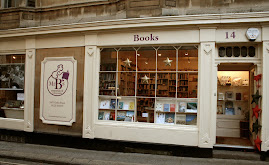
And the Award for The Independent Bookseller of the Year goes to... Mr B's Emporium of Reading Delights! Hooray!

Brimming with excitement and a little bleary-eyed, the Mr B's team have returned from the Book Industry Conference and Bookseller Industry Awards as the proud owners of the Independent Bookseller of the Year Award for 2011!
 The very glitzy awards took place at the Park Lane Hilton in London and were hosted by Danny Wallace (of "Yes Man" fame). We, the B Team (minus Lucinda and Ed who were much missed but busy manning the fort) donned our finest black-tie gear in preparation for a night of eating, drinking, a wee bit of crazy dancing and of course lots of celebrating achievements across the industry.
The very glitzy awards took place at the Park Lane Hilton in London and were hosted by Danny Wallace (of "Yes Man" fame). We, the B Team (minus Lucinda and Ed who were much missed but busy manning the fort) donned our finest black-tie gear in preparation for a night of eating, drinking, a wee bit of crazy dancing and of course lots of celebrating achievements across the industry.In th
 e embarrassingly short taxi ride from our hotel to the party we had all confessed we thought it was unlikely that we would win , owing to the fantastically high standard of the other Indie nominees in our category many of whom we'd been chatting with during the conference itself. In fact, we had our money resting on the gorgeous Gutter Bookshop in Dublin, Ireland, particularly with all their social media wizardry, so we were chuffed when they were given a Highly Commended certificate, along with our friends at The Mainstreet Trading Company. So imagine our uncontrollable glee when the lovely Joanna Trollope called out our names! A great big thanks goes out to Gardners Books, who sponsored the award and presented us with a very generous cheque, which we have mentally spent several times over already!
 The judges generously pointed to our "compelling blend of modern and traditional bookselling" in their commendations as well as the "palpable passion of the staff". That's lovely of them to say but none of that stuff would be true if it wasn't for our wonderful customers - many of whom we know are every bit as book obsessed as us.
 The "traditional bookselling" and "palpable passions" bits are a nod to our hopefully excellent customer service as well as to the way that we bombard you all with recommendations and wax on about our favourite books - if you didn't sometimes trust us with those recommendations and enjoy talking books with us then that certainly wouldn't be award-worthy. The "modern bookselling" is a reference to things like our reading spas and reading years and our themed literary evenings and again neither of those would warrant a gong if it weren't that our customers (a) bought or attended them and (b) told us how much they loved them. So thanks for almost 5 years of loyal book indulgence at Mr B's!
You can read a bit more about the awards on this blog - http://www.bbc.co.uk/news/entertainment-arts-13425666, thanks to which we'll be bigging up the grand work of indie booksellers everywhere on the BBC soon. Watch this space!
Tuesday, 10 May 2011
Ulysses Support Group: Aeolus
Books and food seem to be following me around...this evening's meeting at The Salamander was accompanied by some delicious bar food (thank you Rachel et al!) - and we probably needed the extra sustenance to tackle Joyce's unique presentation of the late morning exploits within the walls of the Freeman's Journal and Evening Telegraph offices. And if you think that was wordy, that's nothing to the language hoops that Joyce puts the reader through in this section. We have transcriptions of spell checks, reverse text as (partly) seen through the eyes of a typesetter, wordplay, limericks and allusions aplenty.
Firstly, we are beginning to realise that Joyce's schemata is only casually based on the form of the Odyssey - this is no simple retelling. Rather, he seems to be picking up on certain symbols or themes and then elaborating. So, our 'winds' in this section, refer to the hot air of the press: letters, adverts, quips, orders, banter and segments of copy fly around and occasionally make sense! Very logical and metaphorical...but then Telemachus (Dadelus) and Odysseus (Bloom) are both present at this early stage (unlike in Homer's original).
The sharp, brief, headline punctuated volleys of dialogue and movement was perceived very differently across the group. Some found it brought back memories of the myriad layers of conversation that flowed around a busy office, whilst others thought that the short and disjointed paragraphs were at times inscrutable, with the result that the reader was never allowed to become truly immersed in the scene. We struggled to identify the supposed 45 styles of rhetoric that Joyce explored during this section, although subconsciously we were probably aware of the different communication techniques employed by each of the staff members, when communicating with peers or superiors. Bloom's 'bit part' functional dialogue was in marked contrast to his extended internal thought processes that the reader was privvy to in the previous section (Hades).
There were several examples in the text where none of us could provide a definitive interpretation and at best we were guessing at whether words and phrases were colloquial stalwarts of early 20th century Dublin or linguistic puzzles. Occasionally, the lack of clarity provided by the notes on word meaning is frustrating, but some of us are happy to accept that they won't understand every reference in detail - and as long as they get some sense of place and atmosphere, don't really mind! This led on to a general discussion about eavesdropping and how you can get the gist of a conversation by continuing to listen, even if you aren't given background info. So, we shall continue to listen (and read) - and any anecdotal examples of the fantastic conversations of strangers can be swapped at the next meeting.
Joyce's treatment of women in this section is similar to that of the milkmaid in 'Telemachus' and we are beginning to see that the female characters are either worshipped at one end of the spectrum or are simply fodder for the men to sharpen their wits on. Are these the only two variations we shall encounter?
Now that we have been presented with three very different voices and styles in the sections that we have covered, the feeling is beginning to emerge that the novelty keeps our interest going - but at the same time, we are relieved that the sections are sufficiently short that we don't tire of the stylistic trickery. Again, the curious mix of non-explanation and myriad tiny details meant we tussled with the question 'Is Joyce is presenting us with a hurriedly written first draft, or a laboured and carefully constructed piece of writing?' My money is on the prospect that we'll be kept guessing throughout the whole book.
So, onward (with enthusiasm). Next meeting is Tuesday 24th May from 6:45pm at The Salamander when we will hopefully have both 'Lestrygonians' and 'Scylla and Charybdis' under our belts - that's about 70 pages in layman's terms!
Firstly, we are beginning to realise that Joyce's schemata is only casually based on the form of the Odyssey - this is no simple retelling. Rather, he seems to be picking up on certain symbols or themes and then elaborating. So, our 'winds' in this section, refer to the hot air of the press: letters, adverts, quips, orders, banter and segments of copy fly around and occasionally make sense! Very logical and metaphorical...but then Telemachus (Dadelus) and Odysseus (Bloom) are both present at this early stage (unlike in Homer's original).
The sharp, brief, headline punctuated volleys of dialogue and movement was perceived very differently across the group. Some found it brought back memories of the myriad layers of conversation that flowed around a busy office, whilst others thought that the short and disjointed paragraphs were at times inscrutable, with the result that the reader was never allowed to become truly immersed in the scene. We struggled to identify the supposed 45 styles of rhetoric that Joyce explored during this section, although subconsciously we were probably aware of the different communication techniques employed by each of the staff members, when communicating with peers or superiors. Bloom's 'bit part' functional dialogue was in marked contrast to his extended internal thought processes that the reader was privvy to in the previous section (Hades).
There were several examples in the text where none of us could provide a definitive interpretation and at best we were guessing at whether words and phrases were colloquial stalwarts of early 20th century Dublin or linguistic puzzles. Occasionally, the lack of clarity provided by the notes on word meaning is frustrating, but some of us are happy to accept that they won't understand every reference in detail - and as long as they get some sense of place and atmosphere, don't really mind! This led on to a general discussion about eavesdropping and how you can get the gist of a conversation by continuing to listen, even if you aren't given background info. So, we shall continue to listen (and read) - and any anecdotal examples of the fantastic conversations of strangers can be swapped at the next meeting.
Joyce's treatment of women in this section is similar to that of the milkmaid in 'Telemachus' and we are beginning to see that the female characters are either worshipped at one end of the spectrum or are simply fodder for the men to sharpen their wits on. Are these the only two variations we shall encounter?
Now that we have been presented with three very different voices and styles in the sections that we have covered, the feeling is beginning to emerge that the novelty keeps our interest going - but at the same time, we are relieved that the sections are sufficiently short that we don't tire of the stylistic trickery. Again, the curious mix of non-explanation and myriad tiny details meant we tussled with the question 'Is Joyce is presenting us with a hurriedly written first draft, or a laboured and carefully constructed piece of writing?' My money is on the prospect that we'll be kept guessing throughout the whole book.
So, onward (with enthusiasm). Next meeting is Tuesday 24th May from 6:45pm at The Salamander when we will hopefully have both 'Lestrygonians' and 'Scylla and Charybdis' under our belts - that's about 70 pages in layman's terms!
Marvellous Monday Book Group: 9th May

 A remarkably sunny
Easter holiday period
accompanied by the
gorgeous prose of
J.L Carr...what could
possibly be better?
Not much, according
to the Marvellous
Monday group, who
were all beguiled by
A Month in the
possibly be better?
Not much, according
to the Marvellous
Monday group, who
were all beguiled by
A Month in the
Country. We completed our 'idyllic English summer' theme with some scones (made by me, courtesy of Oliver Peyton's utterly reliable British Baking) and an impressive Victoria Sponge (made by Chris, courtesy of his own genius). For such a short novella, everyone seemed able to recall very vivid and memorable scenes and the point was made that the succinctness and punch of a short story was successfully carried into a piece of novella length. Often Carr would throw in a piece of detail or character name which was referred to earlier but perhaps without any significance attached to it, resulting in the reader having to re-read sections in order to understand. In a huge tome this might become taxing, but when you are relishing every line, it is almost a relief that you have an excuse to linger over the text. This careful reading was coupled with an undeniable sense of being left wanting more: always a difficult line for an author to tread, but we were unanimous in thinking that the book was far more enjoyable because such a lot was left either unrequited, hanging, or unexplained. It all contributed to the sense of a retrospective, dream like reminiscence of a perfect time. In fact, it made everyone feel nostalgic for rose-tinted summers of our own past! The book provoked discussion about the catharsis of a simple, rural way of life; the way in which outsiders are perceived; morality in the early 20th Century and the difficulty of WWI veterans to share their feelings and experiences of the front line. Phew! The contrast between the upbeat, healing power of environment was of course in direct contrast to our previous read. Next up is Gemma's choice: Italo Calvino's Castle of Crossed Destinies - a group of travellers congregate and share stories. At 14o odd pages, it's another short one, but, being Calvino, I suspect that nothing will be straightforward! Next meeting is on 27th June.
Lucinda
Subscribe to:
Posts (Atom)